Wednesday, March 16, 2011

The Pleasures of Independent Travel


Spending seven hours of watching buses, taxis and pedestrians weave among the diesel fumes of Johor Baru’s Larkin Sentral gave us more than one moment to reflect on the pleasures of independent travel.  

Blowpipe hunter explaining palang piercings

Added to the smell of fuel was the sound. Rising and falling through the grinding sonorities of clashing gears and racing engines, the ululation of bus agent voices added a peculiar background sound like that of auctioneers gone feral in the heat.  At first it is an undecipherable  babble of overlapping cries, but after time it resolves into the sound of men and women calling out the names of the towns to which their company’s bus is heading, each hoping that the volume of their cries will create business and taking obvious pleasure in the percussive rhythm of their own voices.

Our reflection on independent travel focussed on the time we could waste when even slightly indecisive about the destination, and led to some philosophical pondering of how life itself follows the same principle.  As if to reinforce the moral prescription to walk the direct path, Allah placed us on a bus ride that could have been scripted by Disney.

After the 7-hour wait, our bus wheezed into the station and let itself down from the air brakes with a sigh of exhaustion.  The door flopped open and we were invited to board by a negligent flip of the wrist by the driver, who descended looking all around as if for help.

Assistance arrived. The station crew joined the driver, and to Ingrid’s dismay they led him back to the bus and began pointing out the purpose of various switches and controls.  Next they helped him to adjust his seat and ensured he was comfortable.

By this time all the passengers were craning their necks, slightly incredulous about the requirement for instruction in these things.  When all seemed in order, the driver stepped out for a final cigarette, then, grinding the butt into the concrete with the exaggerated toe of his leather shoe and commending with a heavenward glance his soul to the same Allah who had placed us all aboard, he mounted to his seat.

Borneo bus driver completing training.
In the first block out of the station he blew his very first shift and then sat unable to find a way to merge with traffic.  His braking technique was equally uneven, but it required constant use as he experienced great difficulty working his way through the maze of roundabouts and one-way streets.    

Once on the highway and safely through all the gears, our driver attempted to make up in velocity what he lacked in skill. The suspension on the ancient bus could not manage the energies of acceleration, cornering or deceleration, and emphasized his every move, so when he carved around corners at speed, it dipped and bounced and rocked over sideways in an alarming way. From time to time he bottomed out entirely, scraping off fragments of bus undercarriage with a big rough sound. 

Not only did he ignore double white lines to overtake on curves, he tended to drive out there on the wrong side of the road for long stretches of S-bends at whim.  The only bright side to this habit was that it was doubtlessly much less frightening for us than it must have been for the poor oncoming cars.

I found myself peering out into the dark and watching for the kilometer boards to Mersing, not allowing myself the certain hope that we would make it there, but at least consoling myself that the opportunities for disaster were diminishing as the distance shortened.


Eventually we did make it to Mersing, thoroughly chastened and ready to embrace the true path of clarity of purpose.  Since it was so late and we knew hotels would be full, we took the first room we found (and the last room open in the hotel), blowing our budget on a $50 room in the combination of fatigue and gratitude.
After the hair-raising adventure of making it from Kuching to Mersing in one long day, the five hours it took us to book and take the ferry across to Tioman Island was an anti-climax.

Fires under captured heads keep them warm to appease spirits.
And now we sit on a tiny island in the South China Sea, about an hour’s walk along the shore from a duty-free shop where we bought a couple of liters of rum and gin to assist the holiday spirits.  Unless you take scuba lessons, there appears to be nothing to do here, so our tenure might be limited.

Thursday, March 10, 2011

Our maid, like so many Sarawakians, has a mouthful of entirely rotten teeth.  When she smiles you can look directly into a cavern of blackened stumps that even when whole must have represented significantly misshapen dentition. On our first morning here, she was terribly hung over and between that and her boss having the day off, she accomplished almost nothing.  

However, through her personal haze she was able to point us in the direction of the bus to the orang-utan conservancy.

This is not a zoo.  There is no guarantee you will see an orang-utan. But we were fortunate in seeing six.  We have seen four species of monkey now in their natural habitat living relatively undisturbed lives, and the orang-utans stand out.  

Clearly intelligent yet endowed with awesome strength and agility, they move easily through the forest below the canopy using all four hands – as their feet seem (to a casual observer at any rate) to be formed exactly as their hands.  Each limb (whether their extraordinarily long arms or their shorter legs) seems to operate with independence and strength, so they are as likely to hold a bunch of bananas in any fist while clinging easily in mid-air to a few branches or vines with two or three of the remaining appendages.  

Their intelligence and agility seem to support one other personality trait of these big beasts:  a slightly sneering hauteur that is most clearly expressed in their enjoyment of urinating on human groundlings that end up directly below them.  We kept our umbrella up.

The macaques were a problem and would steal food from your plate while you ate.

Saturday, March 5, 2011

More Bood in Malaka


The Taoist elder was hospitable, and before we left he told to return at 8:30 PM for a celebration during which their holy man would sit on a chair of nails.  He eagerly indicated a heavy wooden chair at the side of the temple bristling with clusters of four-inch nails that emerged from the arms, seat and back.  

The evening soon arrived and as we entered from the dark into the ring of light around the temple, everything was bright red and bright yellow.  A puppet show was being staged across from the entrance.  Strangely, this puppet show continued throughout all that followed, as if it were a sub-plot that would not be denied; the oriental Punch and Judy continuing their abrasive dialogue in counterpoint to the main event.

Then, suddenly from within the temple, the cacophonous clash of cymbals beat in synchrony with big drums and immediately hit a pounding, savage rhythm that somehow seemed to echo the pumping of blood.  It was primitive and powerful and incessant.  Incense swirled thick out of the temple as if it were corded around the hammering beat, and the Tao masters began their ceremony.  It had at the same time a colourful, carefully choreographed progression of ceremony and a primitive savagery: it was mesmerizing.

Our senses were filled with reds and yellows and incense and the pounding drums. One agile temple elder capered a bowing and graceful dance to honour the food offerings, then, snapping a long rope like a bullwhip, ushered the priest to a smooth wooden seat. 

At first he sat, head bowed.  But after some time his body began twitching as if uncontrollably, then his bent head began rotating freely back and forth like a manic washing machine.  His thighs began to shake and he stood and faced the congregation, swinging a ceremonial sword above his head and staring into the heavens.  Then he swung the sword down between his legs, then up over his shoulder, faster and faster, flagellating his back – cutting incision after incision into the skin over his right should blade.

Holding the sword in his hand, he led the congregation out into the temple grounds and along a slightly elevated catwalk, before returning to the temple.

Then, as he stood before the table of offerings, the temple elders moved the chair of nails into position.  
Slowly he lowered his buttocks onto the bed of nails. Then he laid his forearms along the nails embedded on the arm rest, and sat back against the nails behind him. 
 
Then, sitting on nails, he then took the same ceremonial sword and held it to his mouth. Pressing his tongue out against the honed edge, he worked the blade up and down with his arms, slicing into his tongue to cause it to bleed.  As the blood ran freely from his mouth, he leaned forward and kissed a bright yellow script of holy paper, painting it with the bright red of his blood before adding some writing then sealing it with a large stamp.  Then he sanctified a second paper. And another. 

Whenever the flow of blood slowed, he would saw the sword against his tongue to freshen the wound and cause the blood to run freely.  All the while the percussive rhythm of drums and cymbals hammered on unabated through the thick drift of incense.  

I checked my watch and realized we had been standing for two hours, and – like most of the congregation – were quite fatigued by the huge sensory input as well as the high drama of the ceremony.  As the pile of holy papers requiring sanctification dwindled, things seemed to relax and wind down.  Attention shifted from the priest.

We edged out to the courtyard and chatted idly with a few members of the congregation.  Somehow the shared experience had created a bond and we were treated to nods and smiles as we slipped into the darkness at the perimeter of the temple lights.  

Walking back into the dark of the sidestreet, we could only look into each others’ eyes and shake our heads mutely.


Wednesday, March 2, 2011

Melaka, Trishaws and a little Castration


It was in Quebec City that the UN declared Melaka a world heritage site, and -- once again boosting Canadian pride -- this fact is billboarded on the side of a building as you jolt into the historic center of this quite remarkable town in a diesel-belching bus with a suspension the same age as the brick-red, 300-year-old Dutch Stadthuys under which you disembark.  If you are fool enough to show up in the choking heat of a Saturday afternoon without a reservation, you deserve to sweat, hump your luggage from hotel to hotel, and listen to the chorus of “Solly. All full.”

Not knowing anyone like that, we are finally staying in the Cheng Ho Guesthouse (at $23 a night, we are once again pushing our budget above the $20 range: I didn’t realize I married a Princess who would want our OWN bathroom).  It is located in the heart of Chinatown where history reaches back 600 years effortlessly.   We are located directly across from the first mosque built in Melaka, only a few doors down from a Buddhist temple, and around the block from a Daoist Temple, where we have already made friends.

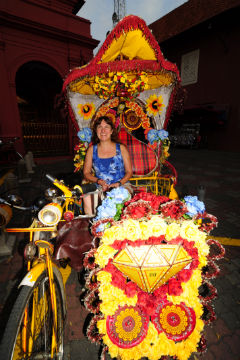
One of the cultural variables that seems to mark Malaysia is the trishaw.  Varying by community, these expensively arcane works of art demonstrate either the endless imaginative ingenuity of the human spirit or the sick obsession with gadgets of the average male: one or the other.   

One rider gave us a tour of his cycle. Of course, all trishaws are required by local ordinance to be entirely covered by a riotous peacock flourish of plastic flowers lit by tiny Christmas-tree LEDs.  With a gesture of pride, our driver showed how his exceeded this minimum standard with coins glued to every surface that would hold glue, a brass civil-war-looking bugle strapped to a handlebar, and six brass, thumb-activated bicycle bells strung under his crossbar.  You might think that six bicycle bells and the glaring gleam of brass would be perfectly adequate to alert pedestrians, but that would be neglecting the culture of trishaw.

A sound system is the true piece de resistance of a Malakan trishaw.  This one featured seat-mounted speakers -- two mid-range and a subwoofer -- powered by a car battery and capable of filling the entire length of the street with classic rock.  That, however, only gets a trishaw rider (not driver – on this they are clear) into the game.  To really compete, the electronic control box by his handlebars must hold an array of switches that trigger ambulance sirens, truck horns and other bits of auditory camouflage.  In cost, a full-decker trishaw runs about the same as a small car, and the competition for outrageous display would make bowerbirds droop their feathers.

A quiet, almost closed chapter in history came wonderfully alive for us with a visit to the Cheng Ho Museum and learned what  a prominent role Mekaka played in the Chinese hegemony over the seas in the 15th century.

Cheng Ho was a eunuch who rose to become the admiral of the largest fleet ever to sail the seas: in fact, at the end of Cheng Ho’s explorations, it would not be for another 500 years that such an armada was assembled.

From his lavishly appointed stateroom on his immense treasure ship (140 meters long, 60 meters wide), Ho led 28,000 sailors in more than 200 ships on seven voyages of diplomacy and exploration through much of the 15th century.  Some of these ships carried treasure to be distributed to the potentates of the new countries they met; hospital ships carried 400 doctors; provisioning ships grew fresh vegetables to prevent scurvy; fighting ships protected the armada. 
However, Cheng Ho paid a price for his eminence.  And he paid it with his testicles.

In order to rise in the hierarchy of the Ming dynasty, a man could not threaten the Emperor’s dominance over his 2,000 concubines.  Being a wary sort, the Emperor suspected that the mere possession of working male parts might seem attractive to at least a few of the 1,999 women he was not satisfying on any one day.  The price of admission into the halls of power was a man’s “precious,” his penis and his testicles.

This might seem like punishment, but in fact it was very costly to be castrated and only wealthy families could offer their 13-year-old sons to the ranks of the Eunuchs.  The operation was done with a relatively small (but hopefully sharp) knife, cutting all evidence of maleness smoothly from the body.  The remaining urinary hole was filled with a metal plug while the young lad spent a very painful three days of fasting.  After three days, the plug was pulled: if he could urinate, he would live.  If no urine passed, he would die.  Two of three died.

It’s interesting to note that the eunuchs would have their “precious” hermetically sealed into a jar they carried with them throughout life to be presented at appropriate occasions and buried with them at death.  A man buried without his precious could not hope to fool the gods into believing he was a complete man, and risked being re-incarnated as a “she-mule” whose lot in life can only be surmised.

The Melaka River runs right through the city.  
Where it meets the sea the great empires 
of the east and west have met for centuries.

Saturday, February 26, 2011

Kuala Lumpur


We were caught at the orchid garden by the afternoon thunderstorm.  In a lull we made it to a taxi stand and jumped into a cab.  A good thing.  As we drove through town the rain increased in volume and the thunder began to speak in no uncertain terms.


I thought in Canada we knew rain.  Apparently we know only drizzle and showers.  The thunder and lightning here were prodigious.  Seldom did the rolling out of one thunderous blast finish before the sizzling crack of the next ripped through the air accompanied by a brilliant flash.  Sometimes the lighting struck in a chain of one-two punches, tearing the air again and again in rapid succession, the ripping sounds overlapping repeatedly before the sonorous bass of the rolling thunder played the coda.  It was a continual and ongoing slam of thunder and in those rare moments the rumbling of the thunder died out, we heard the waterfall splash of torrents of rain hammering the pavement – even from our fourth floor hotel room.  

And as a side note:  I spoke Bahasa Malaysia to the driver of the cab, joking that ini huujam bai untuk taksi – this rain is good for taxis, and he said – in English – you have been travelling in Indonesia.  He explained that I spoke with an Indonesian accent!  Ingrid laughed, saying an English accent she’d understand, maybe some kind of northern bush drawl, but Indonesian?

We read that Malaysia will attain “developed nation” status – if all goes according to the economic plan – by 2020.  As we move around the country we are having difficulty determining what that means. 

The highway between Penang and Kuala Lumpur – which runs a significant way across the country – is of very high standard: six lanes the entire distance providing more capacity than was required the day we drove it.  Other aspects of infrastructure are very evident: rapid transit in KL is extensive and sophisticated and includes an elevated monorail as well as subways, railways and a fleet of air-conditioned surface buses in fine shape.  (On a side note it was with some pride we noticed that the subway system had been built by Bombardier.)

 KL is rife with luxury vehicles and luxury products: the KLCC mall is filled with shops featuring $12,000 watches, $2,000 pens – I don’t know women’s clothing and shoes and purses, but everywhere were designer brands selling for the price of a modest home.  We have hardly seen a woman in the streets not teetering on heels.

There are cranes everywhere you look building high-rises.  All day, and then at night under racks of floodlights huge amounts of inner-city real estate is being developed into wonderful architecture.  The high-tech world is here and capitalism is enjoying a feeding frenzy.

So we are left with a question: what are the key indicators of the difference between a developed and developing nation?  After running through a shopping list of possibles (GDP, maybe GDP per capita, perhaps some measure of health, longevity or education – hygiene or medical care), I was left admiring Bhutan  where the King has determined a significant indicator is Gross National Happiness, measured on an annual basis. 

Upon my return to Canada I will begin a campaign to raise money to send Stephen Harper to Bhutan.  It will be my way of giving back.

Tuesday, February 22, 2011

Leaving Georgetown

Sherlock Holmes once solved a case – I believe it was the Hound of the Baskervilles – by remarking upon the dog that did NOT bark.  Traffic here in Georgetown is mostly remarkable for the thing that is missing: chaos.


Unless you have suffered the confused cacophony of Asian traffic it might mean little to you to know that these people (perhaps one of the legacies of the orderly Brits) obey traffic signals, stay in lanes, indicate turns, and – more remarkably missing than anything else – they do NOT echolocate with their horns.  The streets are relatively calm and tranquil.   

Crossing a street here is no more nerve-wracking than crossing a street in Montreal.  In fact, since these folks actually attend to the colour of traffic lights – it might be a sight safer.

The architecture wonderfully varied, but everywhere the curve.  Overhead you seldom see square corners.  It must take a great deal more effort to shape arches than to build square, yet sidewalk colonnades are arched as are many doorways and entries to public buildings.  It’s visually very pleasing. 

They take the curve motif one step further with the street corners.  Sometimes, rather than abutting at blunt right angles, the streets meet each other in gentler curves, allowing pedestrians and motorists to better see around the corners.  It would be nice to think that this softening of the edges reflected gentler human interactions generally – I guess we’ll see. 

Penang continues to delight us with little discoveries: morning on the Clan Jetties by Quay: here the Chinese have made their livings by the sea, fishing and expanding their neighbourhood out into the ocean on tall stilt houses.

But the big discovery of the day did not come until after the sun had set: Kek Lok Si Temple is the largest Buddhist temple in SE Asia – and that’s saying a lot.  Like so many things in Malaysia, it represents some considerable cooperation, with parts built by Malays, but also bits added on by Chinese and even a nice pagoda to top it off offered by the Burmese.  Fortunately, as we are here around the Chinese New Year, they continue to light the temple at night into a brilliant showcase.


 Kek Lok Si sits above the village of Air Hitam, 
lit only during a period around Chinese New Year.

Saturday, February 19, 2011

Well, after 39 long hours of transit between Terrace and Penang, we have finally found our feet and I have enough energy to make a post to the blog.  And by “found our feet” I mean we have developed rather tender pedal extremities after much walking around the lovely UNESCO world heritage corner of the city of Georgetown.


It’s hard to know quite where to start in an account of this place: the orderly traffic, the wonderful and extraordinarily varied architecture, the exquisite cuisine all vie for a mention, but really, more impressive than any of those is the ancient culture and tradition of inclusion.  

The mutual respect shown by one group to another here is extraordinary.  Muslims, Hindus, Christians and Buddhists do not simply tolerate each other, they appear to honour and respect the cultures other than their own.  On another vector of difference, Indians, Chinese and Malays seem almost proud of each other, proud of their true multiculturalism.  Missing is the slightly sneering disrespect we so often battle in Canada as we struggle to reach “tolerance”: in fact, the whole world could learn a big lesson from the Malaysians about actively celebrating diversity.
 The Masjid Kaptian Keling was built
the first mosque built by Indian Muslims:
its name honours a British Captain.


The historical feel is everywhere.

This trading entrepot sat at the crossroads of the world’s greatest and most powerful civilisations for centuries.  The rich and powerful here were among the richest and most powerful traders on the face of the earth for those centuries, and their mark has remained.

The homes they built and the objects they collected around them are often intact, and the streets are filled with museums, mansions, temples, churches, mosques and gardens built by the elite and maintained or renovated.
 Exquisite glass sculptures fill an entire room of a 
Baba-Noya trader's mansion: extraordinarily eclectic
collectors of the finest arts from around the world.

Once again, though, that gentle Eastern spirit is evident:  in one living museum people were allowed to touch objects, to sit on the elaborately inlaid and carved chairs of the privileged.  Here staircases were closed to the public by the simple expediency of placing a vase of flowers on the treads: no dire warnings, no security cameras, no uniformed compliance officers: just some delicate blooms.  

So we end our first days with delicate blooms.  And sore feet.